Skip to content

Tag: Book Snippet

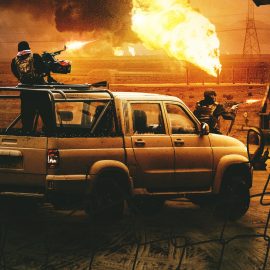
Kill or Capture Chapter 2

John Brannigan was not a happy man.

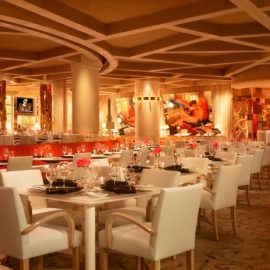
The fact that he was wearing a tux, sitting at a very expensive table in a very expensive, very exclusive restaurant, high atop a luxury hotel in the middle of San Francisco, would have been bad enough.  Ever since his forced retirement from the Marine Corps and the death of his wife, Rebecca, of cancer a short time later, he’d essentially retired to the mountains, living not too differently from an old-time mountain man.  Fancy restaurants, fancy clothes, and big cities put his teeth on edge.  He’d gotten a haircut and shaved his cheeks and chin, but his massive, bristling handlebar remained, setting him apart even more than his broad shoulders and six-foot-four-inch stature from the soft men around him.

But all of that was only a minor annoyance compared to the woman sitting across the table from him.

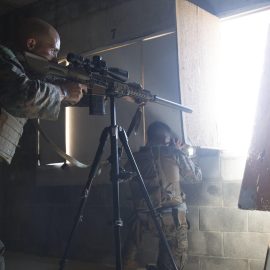
Holding Action Chapter 2

“Shit,” Phil whispered.  “I knew they had a fucking drone up.”

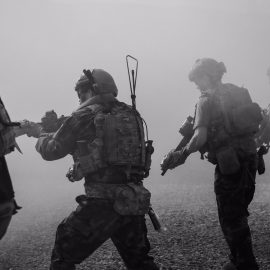
I didn’t answer, but scanned the road carefully.  Once again, thanks to the woods, we were far closer than we should have been, but the spotlights weren’t pointed at the woods, not yet, and the rising growl of the helicopter, along with the rumble of the armored cars’ diesels, seemed to have drowned out what little noise we were making.  Slowly, carefully, I eased back deeper into the shadows, Phil doing the same.

Looking up and down the road, I didn’t see a good spot to cross.  The six armored vehicles were spaced out along the road.  They were too close to slip through, and too spread out to find a good spot to go around.  At least, not with that helicopter closing in.  Two klicks of open country separated us from the border at its nearest point, and that would have entailed going through Leuba.

As urgent as it was that we get the information back to Poland, we weren’t going to do anyone any good if we went charging out there and got killed or captured.  And as confident as I was in my team in combat, the numbers out there on the road were telling.  Especially with armored vehicles mounting remote-operated machineguns.  Doesn’t matter how good you are, bucking a stacked deck like that is just going to get you killed.

“Back into the trees,” I whispered as Phil got close enough.  “We’re going to have to lay low and wait.”  I knew as well as he did that that could still go very, very wrong.  We had maybe three square miles of woods to hide in, and they were crisscrossed with trails and bike paths.  And the leaves were falling.  We were on the clock, whatever we decided to do.

Whatever I decided to do.  We might be a team, but I was still team leader, and democracy in a combat situation is always a bad idea.  The buck stops here.  I could, and would, take input from the team when possible, but at the end of the day, the decisions were mine.

Don’t think that’s power-tripping.  It’s one hell of a responsibility, especially when more than the other eight guys on your team have their lives in your hands.

The two of us moved slowly and carefully back into the trees.  We hadn’t overpenetrated into the open field, but the trees were still thin enough that if we moved too quickly, we might well still get spotted.  The eye is drawn to movement, which is why stalking is often so slow and painstaking.

So far, they hadn’t turned those spotlights on the treeline.  So far.  If they were set up on that road, it meant that they suspected that somebody was running around in the woods around Görlitz.  If they started actively hunting, I was sure that those lights were going to come into play.

The question was whether they were in place just to watch and wait, or were actively looking for us.  I didn’t think we’d done anything to compromise ourselves, so I expected that they were just in place as a tripwire.

Holding Action Chapter 1

On the ground, at night, Germany didn’t look all that different from Slovakia.  The differences lay in details that might not have been all that readily apparent to someone without our recent experience.

Aside from a dog barking down by Schönau-Berzdorf, it was deathly quiet.  No distant thunder of artillery rumbled.  No small arms fire rattled.  There weren’t even any aircraft to be heard in the sky.

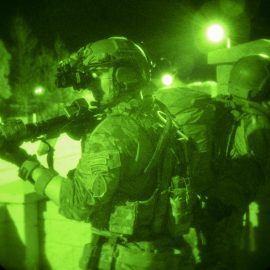
The lights were still on in Görlitz to the north, casting an orange glow against the low clouds overhead.  Unlike the all-too common flickering light of burning towns and villages in Slovakia, it was a steady illumination, adding to the ambient light that our AN-PSQ-20 fusion goggles had to work with.  It made navigation through the shadows of the German woods quite a bit easier.

That same quiet was making me suspicious.  The entire landscape around us seemed asleep and dead.  Given that every indicator that intelligence had gotten in the last few weeks was pointing to Görlitz being the staging point for a major offensive aimed at Poland, there should have been more activity.

Phil Kerr took a knee next to a mostly-bare tree.  The fall had been colder than the Poles said was normal, and the leaves were falling fast.  It was a bit of a disadvantage for us; we needed that foliage to cover us from the air.

Not that there seemed to be anything in the sky but the owls, that night.

“This is creeping me out, man,” Phil whispered as I knelt next to him.  “I can’t even hear any drones.  It’s like they’re not even keeping an eye on the border.”

“Oh, they’re keeping an eye on it,” I replied.  “They’re just being careful about it.”  I glanced up at the sky.  If there were drones up there, they were the high-altitude, stealthy variety, that we wouldn’t see or hear until it was too late.  And there wasn’t nearly enough overhead concealment to keep us hidden if there was.

The truth was, it was still odd.  Most mechanized formations used a swarm of small, low-altitude recon drones in a sort of bubble around them, extending their eyes several hundred meters.  The drones were cheap, they were easy to recharge, and they were a lot easier to keep tabs on at a tactical level.  The bigger, high-altitude jobs usually piped their feeds back to theater-level control hubs, and then had to be sent to the end-user TOCs.  They had their place, but for a battalion-sized mechanized unit to have no close-range drones out was just weird.

I peered through the boles of the trees ahead, but we were still too far back in the patch of woods north of Jauernick to be able to see our first Named Area of Interest, which recon flights on the Polish side of the border had tentatively identified as a mechanized battalion assembly area.  It wasn’t a FOB; we’d be able to see it from a mile away if it had been; the Bundeswehr seemed to be lighting their bases up like Christmas trees for security.

Phil’s unease wasn’t misplaced.  After all, we were in enemy territory, and when the enemy started acting unpredictably, that was usually bad news.

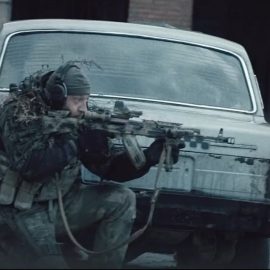
ESCALATION Chapter 1


The bad guys suddenly started moving about an hour after sunrise.

We had eyes on two sides of the house from our hide site, and so it was impossible to miss when the front door slammed open and half a dozen men rushed out, bearded and armed to the teeth.  The only one who wasn’t in a rush was the guy with the Talib beard, wearing all Russian camouflage and talking into a radio.  We were so close that I could actually pick out a few of the Albanian words.

I was already nervous about being within a hundred meters of the target building, but having what looked an awful lot like a terrorist react force come rushing out made my guts pucker.  Only training and discipline kept me stock-still, though my hand was already on my OBR’s firing control, finger hovering near the trigger.  If we’d been made, it was going to get really loud and really messy, really fast.

We were also probably all going to die in the process.  Not to mention the hostage whom I was already pretty sure was tied up inside that house.

“Deacon, Weeb,” Scott Hayes’ voice said in my ear.  “I think I see what’s got ‘em all stirred up.  There’s company coming.”

I didn’t answer right away.  I was keeping my eyes fixed somewhere just above Camouflage Jacket’s shoulder as I inched my off hand toward the push-to-talk clipped to the strap of my chest rig.

None of us had wanted to set up so close.  Phil had been downright adamant that we needed to find some other way of handling the situation, as the night had worn on and we’d had to get closer and closer just to see the house through the trees.  The hills we’d hiked in through were heavily forested, and just the crunch of leaves under our boots had been excruciatingly loud.

And if I could hear the guy who I was pretty sure was Ibrahim Baruti, then he could hear me.

(Continued from the Escalation Prologue)