Skip to content

Tag: Action Adventure Books

The Guns of Kill or Capture

Yes, it is time for a guns post again.  What kind of hardware shows up in the seventh outing for Brannigan’s Blackhearts?

The Blackhearts get to pick their loadout before insert this time, as opposed to some of their previous adventures.  But with the AO being in South America, they’ve still got to find weaponry that will, if not blend in in South America, at least be compatible for ammo resupply.

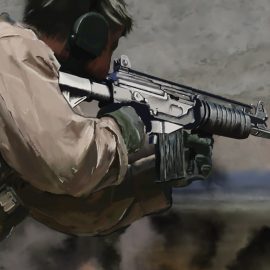
Wade selects the IWI ACE 52 for their rifles.  The ACE is an updated version of the Galil, and the ACE 52 is chambered in 7.62×51.  It’s been adopted by several South American special operations forces, including in Argentina.

Kill or Capture Chapter 1

Special Agent Vito Castiglione looked up from the spotting scope as the door opened behind him.  Special Agent Cara Hernandez walked into the room and stood next to him, peering out through the black mesh laid over the gap in the curtains.

“Aren’t you supposed to be keeping eyes on the objective?” she asked.

“Nobody’s budged out of that place in the last thirty-six hours,” Castiglione said dismissively.  “We’ve got the whole place tied up tight.  Besides, have you seen the pictures of this guy?  I don’t think we really have much to worry about.”  The fact that he was admiring the view presented by the willowy, olive-skinned Special Agent next to him was beside the point.  She was much more interesting to look at than the dull, expensive house across the street.

She rolled her eyes at him, exasperated.  He just leered back.

“Yes, I have seen the photos,” she said.  “Still, you should at least pretend to be taking this warrant seriously.”

“What’s to take seriously right now?” Castiglione replied.  “He’s a pasty-white billionaire wanted for bribery, money laundering, and influence peddling.  He’s hardly Abdullah Ahmed Abdullah.  The whole point of putting an Enhanced SWAT team on him is to send a message, and none of the cameras are here yet.”

“The cameras might not be,” Hernandez replied, glancing over her shoulder, “but there are other people here who don’t seem to have much of a sense of humor.”  She nodded toward the door as her tone dropped.  “That one in particular,” she added as she turned back to the window.

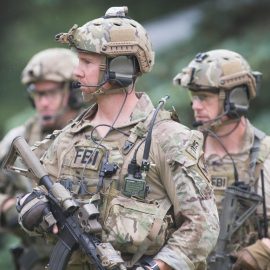
Castiglione looked over his shoulder at the door behind him as a short, severe-looking woman, who appeared to be in her late fifties, walked in, flanked by two men in plaid shirts and jeans, who nevertheless had that aura of barely-restrained violence that he’d come to associate with special operators.  Castiglione hadn’t ever served in the military; he’d been a SWAT cop in Chicago before he’d signed on with the Bureau.  He generally disliked the special forces types, just on general principles.  They usually thought they were gods among men, and looked down on “humble” law enforcement guys like him.

But a glance from the woman in her simple but businesslike suit got him turning around and putting his eye back to the spotting scope hurriedly.  He didn’t know who she was, but if she was walking around the FBI’s cordon with that kind of impunity—he didn’t even see a handler, and Special Agent Dover was usually a stickler about such things—she had to have some serious pull.

“I assure you, Special Agent Castiglione,” the woman said, her voice full of ice, “that having an Enhanced SWAT team here is most certainly not simply to ‘send a message.’  The only reason you and your team are here instead of the HRT itself is because you were closer.”

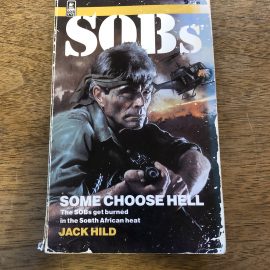
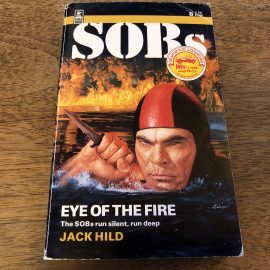
SOBs – Eye of the Fire

Since I’m working on Brannigan’s Blackhearts #7 – Kill or Capture, I’ve been back to the SOBs series for some reading.  Which is when I realized that I haven’t written up the last few I’ve read.  So, here is Eye of the Fire.

Eye of the Fire has a couple of things going on.  The mission is an assassination in Cuba.  But the target isn’t a Communist official or guerrilla leader.  He’s an Argentinian known only as “Colonel D,” a torturer-for-hire who has spent decades finding inventive ways of making Communists die in agony throughout Latin America.  And, coincidentally, he’s also been employed by the CIA.

This makes him valuable to several people.  Jessup, “The Fixer” hires the SOBs to take him out in order to keep him from burning his contacts with the Agency.  Barrabas isn’t having any of it to start with; he says he’s a soldier, not an executioner.

But the mission isn’t the only thread in this book.  There are a couple of others, that make things much more interesting.

Holding Action Chapter 1

On the ground, at night, Germany didn’t look all that different from Slovakia.  The differences lay in details that might not have been all that readily apparent to someone without our recent experience.

Aside from a dog barking down by Schönau-Berzdorf, it was deathly quiet.  No distant thunder of artillery rumbled.  No small arms fire rattled.  There weren’t even any aircraft to be heard in the sky.

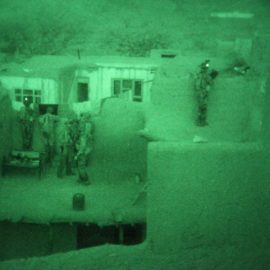
The lights were still on in Görlitz to the north, casting an orange glow against the low clouds overhead.  Unlike the all-too common flickering light of burning towns and villages in Slovakia, it was a steady illumination, adding to the ambient light that our AN-PSQ-20 fusion goggles had to work with.  It made navigation through the shadows of the German woods quite a bit easier.

That same quiet was making me suspicious.  The entire landscape around us seemed asleep and dead.  Given that every indicator that intelligence had gotten in the last few weeks was pointing to Görlitz being the staging point for a major offensive aimed at Poland, there should have been more activity.

Phil Kerr took a knee next to a mostly-bare tree.  The fall had been colder than the Poles said was normal, and the leaves were falling fast.  It was a bit of a disadvantage for us; we needed that foliage to cover us from the air.

Not that there seemed to be anything in the sky but the owls, that night.

“This is creeping me out, man,” Phil whispered as I knelt next to him.  “I can’t even hear any drones.  It’s like they’re not even keeping an eye on the border.”

“Oh, they’re keeping an eye on it,” I replied.  “They’re just being careful about it.”  I glanced up at the sky.  If there were drones up there, they were the high-altitude, stealthy variety, that we wouldn’t see or hear until it was too late.  And there wasn’t nearly enough overhead concealment to keep us hidden if there was.

The truth was, it was still odd.  Most mechanized formations used a swarm of small, low-altitude recon drones in a sort of bubble around them, extending their eyes several hundred meters.  The drones were cheap, they were easy to recharge, and they were a lot easier to keep tabs on at a tactical level.  The bigger, high-altitude jobs usually piped their feeds back to theater-level control hubs, and then had to be sent to the end-user TOCs.  They had their place, but for a battalion-sized mechanized unit to have no close-range drones out was just weird.

I peered through the boles of the trees ahead, but we were still too far back in the patch of woods north of Jauernick to be able to see our first Named Area of Interest, which recon flights on the Polish side of the border had tentatively identified as a mechanized battalion assembly area.  It wasn’t a FOB; we’d be able to see it from a mile away if it had been; the Bundeswehr seemed to be lighting their bases up like Christmas trees for security.

Phil’s unease wasn’t misplaced.  After all, we were in enemy territory, and when the enemy started acting unpredictably, that was usually bad news.

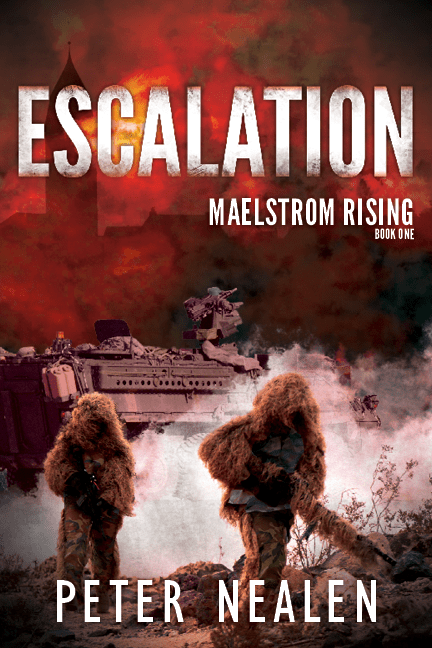
ESCALATION Chapter 2

“Friendlies coming in,” I called over the radio.

“I’ve got you,” Tony replied.  “Come ahead.”

It was almost dark.  As thick as the woods were in that part of Slovakia, we’d had to move very carefully to avoid the locals, not to mention the occasional peacekeeper or militia patrols.  It had taken slow, methodical movement, slipping from cover to cover, often halting to stay put and just watch and listen.

Phil got to his feet and started toward the ancient barn.  Built of plastered stone and graying, aged timber, the roof was starting to sag and the base was overgrown, but it was still solid.  I suspected it had been standing for at least a couple of centuries.  It probably would still have been in use if not for the turmoil that had engulfed Slovakia over the last few years.

I carefully scanned the surrounding woods and the open field beyond for a moment, despite the fact that I knew that Scott had security set and the drone up.  The abandoned farm sat right at the no-man’s land between the Belgian peacekeeping sector and one of the few, small, Loyalist Slovak Army sectors.  While what was left of the Army that hadn’t gone over to the Nationalists after the initial riots was still outwardly loyal to the shaky government in Bratislava, that loyalty was in question among many of the peacekeepers, especially the Germans and Belgians.  None of this would have been happening if the Slovaks hadn’t already had enough of both Brussels’ financial demands and the forced immigration, mostly of young Kosovar, Bosnian, and Syrian men.  To that end, most of the EDC peacekeepers made no secret of the fact that they didn’t trust the Slovak Army.

Which made the uneasy borders between zones the best place to hide out, even though it had meant one hell of an infiltration from Hungary.

(Continued from Escalation Chapter 1)

ESCALATION Prologue


Missiles Fly Over the East China Sea

 Chinese People’s Liberation Army Navy ships exchanged antiship missile fire with the Japanese Kaga task force off the coast of Fuke-jima in the early hours of Wednesday morning.  It is unclear whether or not the Chinese ships had actually passed into Japanese waters, though Beijing denies any such incursion.  Japanese Navy spokesman Rear Admiral Hideo Hayashi insisted that the Chinese ships entered the Kaga task force’s exclusion zone, the fifth such incursion within the last three months, though he did not deny that the Japanese ships fired first.

The Chinese deny that any major damage was done, claiming that their point-defenses shot down all incoming missiles.  However, sources claim that the frigate Yiyang was observed listing seriously and possibly burning.


Violence Spreads to Palawan

 The battle over the Spratly Islands has spread to the Philippine Island of Palawan.  While the PLAN remains offshore, Filipino authorities are insisting that the increasingly effective paramilitaries operating on Palawan are in fact Chinese proxies.  Senator Joniel Bautista has even accused the People’s Republic of China of smuggling PLA commandos onto the island.  Paramilitaries have seized control of Puerto Princesca International Airport, and a combined force of Filipino and Vietnamese troops have been attempting to regain control of the airport for the last three days.  The death toll continues to rise.


Korean Unification Talks Continue to Stagnate

Representatives from the ROK and the DPRK met again on Tuesday, only to go into recess for the fourth time without progress.  While the official statements from both governments insist that talks are continuing, there have been no changes in the last six months.  Sources say that Pyongyang is under increasing pressure from the People’s Republic of China to remain in Beijing’s orbit, and that any unification that does not include a close partnership with China will have serious consequences.  Meanwhile, increasing Japanese navy patrols near the Korean coast have Seoul worried about taking sides between the increasingly hostile Asian powers.