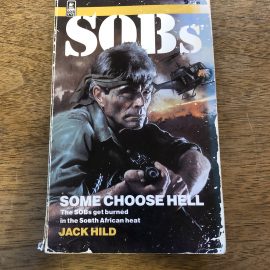
Some Choose Hell is the 9th Soldiers of Barrabas story, and takes the SOBs to South Africa. South Africa in 1985, when apartheid is alive…
Peter Nealen - Veteran and Author
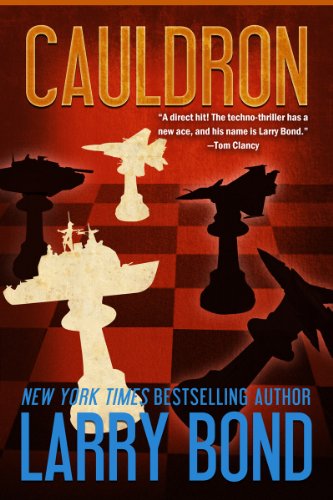
I first read Cauldron in high school, and at the time, I remember that it didn’t make as much of an impact on me as Red Storm Rising, Red Phoenix, or even Vortex did. A new war in Central Europe seemed somewhat more far-fetched at the time than chaos in Africa or East Asia. (I was in high school; I didn’t know nearly as much as I might have thought that I did.)
But in prep for Maelstrom Rising, I picked Cauldron back up. And I’ve got to say, Larry Bond was a lot more prescient than he seemed, back in ’93.
While the general scenario in Cauldron is the French and Germans enforcing their economic hegemony over Eastern and Central Europe by force of arms, effectively forming the European Union at gunpoint (referred to as the European Confederation, or EurCon in the novel), the fault lines that lead to the scenario are even now playing out, only slightly differently.
I’ve made no secret of the fact that in many ways, the Brannigan’s Blackhearts series is a bit of a throwback to the glory days of Men’s Adventure fiction, most exemplified by The Executioner, Phoenix Force, Able Team, the SOBs, and similar series.
Mark Allen’s Warlock is the same thing, if in a slightly different direction. The cover should be a dead giveaway, too; it looks like a Mack Bolan cover.
So, it took me a while to get through this one (sorry, J.T.!). J.T. Patten did warn me that he considered the second novel, Primed Charge, to be much better written. While I can see why, this book is no slouch on its own.
Sean Havens is a spook’s spook. He doesn’t have a formal cover; he doesn’t even directly work for any agency. He’s a contractor, who goes to various countries as a corporate drone of some kind, blends in, learns the human terrain, and then manipulates it to a desired outcome. Somewhere nearby, people die, and he goes home to his family, completely unconnected.
Except that, despite his paranoia (which is impressive, by the way), there are still people who know who he is. And they know where his family is. That leads to a personal tragedy that draws Havens into something far darker than anything he’s been involved in yet (and he’s been hip-deep in some pretty dark stuff, as you discover as the book goes on).
Over on Steemit, Ben Cheah has posted his review of the entirety of the American Praetorians series. It’s mostly praise, with some critiques. Read it…
I originally wrote this for Breach-Bang-Clear a while back, but it seems to have gotten lost in the shuffle, so here it is.
Line in the Valley is hard to categorize. It’s a crime novel, a war novel, and a psychological study of men under the highest possible stress in combat, all at the same time. It’s set against a backdrop of an invasion of South Texas, but that really only sets the background against which the events take place.
The story starts off with a bang, as advance elements made up of local gang-bangers eliminate all the cops in the target border towns. It then follows the initial response, which goes very badly, before we get into the nitty gritty of the counterattack, which is where the meat of the story happens.